I grew up with Mario, I am a through and through Nintendo fan boy. This was the first game I’ve ever owned and I still remember the excitement that filled me in Cornelscourt shopping centre when the S.N.E.S. was placed in the shopping trolley. The film could charitably be classed as "borrowing" although this should be more accurately described as a travesty.
An incredible amount of, ahem, artistic licence has been taken with this conversion from game to film and all of the changes have been detrimental. The setting, the characters, the style, the tone every element of the story have been mangled beyond recognition. And one has to wonder and lament, why? The Tag line for the film was "this ain't no game". Well it wasn't a picnic to watch either.
In the game a charming overly Italian, New York plumber by the ingenious name of Mario Mario, who falls in madly in love with the perpetually kidnapped Princess Peach after travelling into the kaleidoscope of colours that it the Mushroom Room kingdom. He must save his beloved from the grip of King Koopa a rather cute looking Dinosaur and his army of even cuter turtles. He is helped along the way by the Mushroom people specifically Toad, and his loyal younger brother, Luigi Mario, and their cute bright green pet dinosaur Yoshi, who oddly despite his male gender shoots out eggs. Along the way Mario ate “magic mushrooms” to gain special powers which gave the whole game a great Alice in Wonderland feel. It was nonsensical experience that treated logic with wild abandon. In other words bliss to play.
The film is anything but.

The film sought to appeal to an older audience and took many liberties to achieve this.The exuberant world of the mushroom kingdom has been replaced by a dire environment which feels like a poor Blade Runner rip-off. The object of Mario’s, played by the English actor Bob Hopkins, desire; Princess Daisy is now the object of the younger Luigi’s affections, played by a moustache-less, which is shocking considering the moustache is a defining motif of their character design, John Leguizamo. Perhaps the film producers found the age difference to be too “racy” despite paradoxically trying to appeal more edgy. Koopa, played by a punk version of Dennis Hopper, was now a humanoid descendant of Tyrannosaurus Rex and his cute army had become an ugly shuffling army of tall gangly figures with inexplicitly small heads with rather monstrous features. Toad, who is now also humanoid and no longer a mushroom, is turned into one of Koopa henchmen but never given the screen time to become appealing or develop any level of apathy with. As for the cute pet Yoshi he now looks like a scary Jurassic Park reject that no longer shoots eggs. Gone is the Alice in Wonderland-esque power ups replaced with non inspired technological replacements which lack any real soul. The Film has lost everything in Translation.
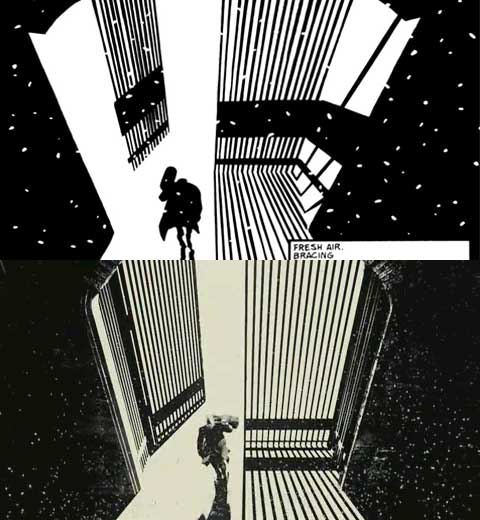
My second adaption I shall discuss is Sin City. This was an adaption from a graphic novel into a film. This adaption had a much higher level of fidelity to the original than that of the Mario film. This adaption could easily be placed within the “transforming” type of conversion. In this case the original was handled with much more reverence, which was clear from the Author of the original Frank Miller being on set as a hands-on advisor to the production. The close similarities between the process of storyboarding and the medium of original comic book, with several very important differences of course, was fully exploited by the production to help create a more faithful adaption to the screen with the original comic’s “panels” being used to help shape the image on the screen. However there were several differences that occurred as an unavoidable consequence of the adaption.
The most evident consequence in the process of adaption is the loss of subjectivity of the original in areas such as character and timing in the new film medium. Although you would imagine that a comic book would offer the creator a high level of control over the affect the finished product will have on the audience there are many areas out of their control. One of these areas is the voice of the character, when I read a speech bubble, the voice my imagination assigns may be very different from that of the next reader. Even in areas such as the way the visuals of the narrative affect me are vastly different, despite the fact the film uses the original images as guides and tried to stick as closely as possible to them they will both have very different affects on the audience. This has to do with the power and universality of cartoons versus the specific nature of live action. By simplifying a character it allows the audiences more scope to imbue that character with more personal traits of the audience member. There is not as much scope to assign these personal virtues upon the more concrete image of the live action character.


Excellent.
ReplyDelete[full marks]